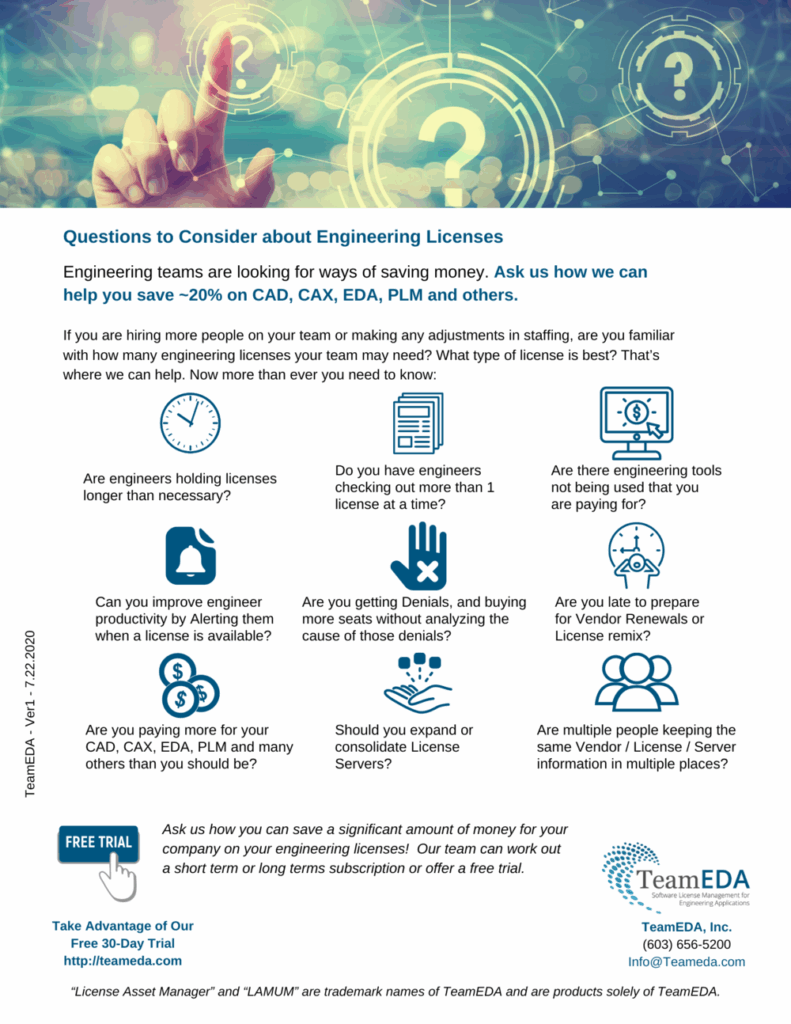
Questions to Consider About Engineering Licenses

Engineering teams are looking for ways of saving money. You are probably spending a lot on CAD / CAE / CAM / PLM software. Ask us how we can help you save ~20% of that cost.

If you are hiring more people on your team or making any adjustments in staffing, are you familiar with how many engineering licenses your team may need? What type of license is best? That’s where we can help. Now more than ever you need to know:

  • Are engineers holding licenses longer than necessary?
  • Do you have engineers checking out more than 1 license at a time?
  • Are there engineering tools not being used that you are paying for?
  • Can you improve engineer productivity by Alerting them when a license is available?
  • Are you getting Denials, and buying more seats without analyzing the cause of those denials?
  • Are you late to prepare for Vendor Renewals or License remix?
  • Are you paying more for your CAD, CAX, EDA, PLM licenses than you should be?
  • Should you expand or consolidate License Servers?
  • Are multiple people keeping the same Vendor/License/Server information in multiple places?  Wouldn’t it better to centralize and share the same information?

Ask us how you can save a significant amount of money for your company on your engineering licenses!

Our team can work out a short term or long terms subscription or offer a free trial.

Saving on Engineering Software – Adapting During These Changing Times

LAMUM can save engineering teams on an average of 20% per year in CAD / CAE / EDA / PLM costs, money that you are already spending, but unnecessarily. Yes, you will have to spend a little for LAMUM, but you will save a lot. ROI is greater than 1,000% (ask our team and we can show you the math).

Engineering IT asset management reporting tools are helpful in evaluating the following and making better decisions:

  • Do your current engineering software licenses align with your business objectives?
  • Can you benefit by preparing better before renewals?
  • Where are there potential cost savings?
  • What are the expectations for future usage?
  • Are the denials real?

Every 100 engineers requires $250k per year in Engineering software. Spending $5k to save 20% of $250k ($50k per year) is simply a good investment.

Buying more CAD / CAE / EDA / PLM licenses because some engineer said he could not get a license is not good practice. Denials occur for many reasons other than simply running out of licenses.  We can show you when and why Denials are occurring.

Why continue to renew engineering tools that are not being used? Being better prepared to negotiate renewals with vendors can save 5-10% of the costs.  LAMUM will help you be better prepared. That is happening, and we can show you where.

A tool like LAMUM can also help you:

  • Improve utilization of the software that you already own
  • Improve engineer’s productivity and identify training needs
  • Centralize and share Vendor, Contacts, License Server, and Renewal information.

Of course, you may be wondering “how is it possible to save that much per year in CAD / CAE / EDA / PLM?” The free 30 day trial will allow you to see where the savings will come from. You can use the reports generated by LAMUM to convince your management on the importance of having LAMUM.

Chargebacks for Engineering Software

Chargebacks for engineering software are crucial but take so much time. What if there is an easier way? Engineering teams are consistently asked to align with business objectives through ensuring costs and charges are billed back appropriately by manager, project, or department.

Would you like to have an easy way of seeing how your engineering teams are spending their time and which expensive software they are using?

Managers need to consider the best ways to make decisions about:

  • Cost allocations and overall Engineering expenditure
  • Intelligent use of engineering resources
  • Spending restrictions
  • Resource distribution

Here are some challenges managers in different roles face with chargebacks:

  • Are engineering software costs escalating every year?
  • What are the current and future staffing and project costs?
  • Is there increasingly less transparency about how costs are calculated?
  • Would it be helpful to see regular/monthly running totals of costs to ensure they are tracking to budget?
  • What is the best way to ensure all groups have the licenses they need (for individual users or groups)?
  • Is there a more efficient way to avoid wasting too much time calculating costs for licenses? (Hint: LAMUM can help you here).
  • What are the considerations if staff leave or there are new starters? How do you pro-rate the costs?
  • Are there different types of users – depending on how frequently they use engineering software?
  • How to create “unbiased“ reports?

To achieve an efficient engineering chargeback process, accurate software usage metering is crucial. We have discussed in our blog before about how different reports help managers make educated decisions.

How can easier to use chargeback reports help you?

Accurate, unbiased chargeback reports help you to:

  • Create cost allocation system and improve cost-awareness
  • Discover opportunities for optimization
  • Enhance business productivity
  • Enterprise-wide accurate license usage reports
  • Identify the true active usage
  • Internal billing based on actual use
  • Optimize resource planning and efficiency
  • Simplify audits
  • Track and recover unused software licenses (See our recent blog)
How can LAMUM reports help us?

We have developed the LAM (License Asset Manager) side of our business for a long time. LAM can help you track the information you need including cost of licenses. We are proud to over the years have developed a one-stop-shop solution to managing licenses, software asset tracking and usage reporting all in one place. Our tool is very comprehensive.

Did you know that you can see automatically a chargeback percentage? Our reports highlight comprehensive information for every feature and license file that is tracked, allowing for a completely granular IT chargeback process.

All of the reporting data from LAMUM can be exported to Excel at the click of a button or via a batch report (email or folder-based). See an example of a chargeback report for NX here.

How Much is Your Company Spending on Unused Engineering Software?

A CIO article reported about a study that highlighted that “U.S. organizations wasted $30 billion on unused software over the course of a four-year study.” Does your company spend money on engineering licenses that the team does not use? How much is your company and engineering team wasting on these unused resources?

To gain competitive advantage, many teams are collecting and analyzing as much data as possible. However, sometimes there is so much data and it is unclear how much value is behind this data. Are you sure your team is drawing the right insights from your reports? We have found that often faulty data makes teams counterproductive and leads to wrong conclusions. Our team is proud that our data is 100% accurate since our solution is proprietary.

Managing who has which licenses and reporting on what they are actually using has traditionally been a time-consuming process of manually retrieving and compiling data. Our tool helps managers save time by having quick and easy-to-use reports. Save your resources by optimizing your processes. With next-generation enterprise-ready data virtualization, our reports make it easy to see all the reports as well as prepare further reports for upper leadership. Consider consolidating the reporting of your engineering asset information in one place.

Monitoring and measuring engineering software usage and asset data will allow engineering managers to make better educated decisions of how to best invest in expensive engineering licenses. Managers can also use historical asset and usage data to see, in near real-time, see changes in usage to determine any decisions that need to be made.

There is constant pressure for IT to reduce cost and do more with less especially in these challenging times. Is this one of your priorities or KPIs this year? How can you maximize the value of your engineering software? Learn how engineering licensed asset management saves top engineering companies 15 to 20% on their software costs year-on-year,

Are Engineering Licenses Causing Bottlenecks & Slowing Down Your Team?

As a manager, you’re in charge of many aspects of your department. Are you and your team spending your time effectively? You know you need to be prepared for and anticipate the ever-expanding expectations. In the current economy and state, it is often a a greater challenge with many unknowns. What could be helpful is to have an easy to use tool where you can see all the reporting. Can you use your FlexLM licenses in a smarter way?

Better manage engineering teams on time and within budget.

By looking at usage, you could notice if employees are not able to work efficiently because they may not have access to needed tools. This could, of course, lead to bottleneck and slowing down. Do you want all of your employees to be able to work at maximum efficiency? Is there a way to cut down on unproductive hours?

In today’s fast-paced and digital business world, managers must think about digital transformation. With automated reporting, you will save a lot of time and hassle, while increasing your team’s productivity and effectiveness. Effective planning can empower you to adapt to any unanticipated speed bumps. What bottlenecks are causing your team to slow down development work?

Rearranging Engineering License Estates

In many global companies, engineering teams are spread around the world. Are you responsible for hundreds of Autodesk, Siemens, PTC, Creo or Solidworks licenses?

For example, do you have 20% of engineers working in UK that would require their own engineering licenses purchased in that country. Then, 40% of your engineers are located in Hong Kong. Yet, 40% of the other engineers are located in India. This could get even more complex. What if your engineers transfer between different countries or your company decides to hire more or less of particular engineers in your region?

Do you have an easy to use system in place to oversee and manage all of these engineering licenses? How are your engineering budgets allocated in different regions?

Do you need to have license servers set up in every country?

Contact our team to learn more about how TeamEDA can help you optimize your engineering licensed assets.

An Introduction to Engineering Software

This article – “An introduction to Engineering software”  was written by Rich Gibbons, ITAM Review and Paul Empringham, European Sales Director, TeamEDA. Originally published in the ITAM Review.

What are Engineering tools?

A class of software exists in many companies that collectively is known as; “Engineering Software”, typically it is used within organizations providing new product development (NPD) or maintenance, service and overhaul (MSO) services. This software has traditionally been purchased and owned at engineering department level, so there is often a reluctance to allow SAM managers or ITAM processes to assist in managing these applications.

Industry verticals such as Aerospace & Defense or Automotive have led industry adoption, so their supply chain networks tend to have the most mature digital development processes, with the following software architecture:

  • Model Based System Engineering (MBSE) – Requirements and Planning
  • Computer Aided Design (CAD) – Virtual product development
  • Electronic Design Automation (EDA) – Tools for validating integrated circuits and PCBs
  • Simulation Tools: Finite Element Analysis (FEA) – Computation Fluid Dynamics (CFD), etc.
  • Product Lifecycle Management (PLM) – Collaborative Data Management tools
  • Mixed Reality (XR) – incorporating Virtual Reality (VR) and Augmented Reality (AR)
  • Geographic Information System (GIS) – The organization of data relating to position

The trend over the last decade has seen many products incorporate IOT technology, delivering a new connected experience into anything from lightbulbs to lawnmowers. This requires design teams to converge mechanical, electronic, and software design simultaneously to deliver products – which has resulted in a big increase in engineering software spend.

Industry verticals such as Architecture, Engineering and Construction (AEC), traditionally developed all deliverables as 2D drawings in tools like AutoCAD. With the introduction of Building Information Modeling (BIM), engineers are beginning to incorporate re-usable 3D modeling processes enabling predictive maintenance and servicing.

Software vendors commonly associated with Engineering Software are AutodeskDassault SystèmesSiemens Digital Industries SoftwarePTCAnsysHexagonAltair, etc.

How is Engineering Software different from Business software?

Cost

Engineering tools are designed to save companies considerable time and complexity, it is therefore priced accordingly. For example, a base CAD modelling package may cost £7,000, but a package suited to an automotive designer could be in excess of £50k per seat. Many software tools require a team (or outsourced company) to manage the data, processes and upgrades, which adds a substantial overhead to the cost per license.

User allocation

Unlike more traditional products from vendors such as Microsoft or Adobe, where software is allocated for months or years, engineering software is allocated on a dynamic basis over hours and minutes. The software is run from a central license server, typically FlexNet/FlexLM from Flexera although similar derivatives exist. This allows for a greater ratio of users per licenses owned. Often companies work on a two thirds rule, with 200 licenses serving 300 users.

Licensing models

Engineering Software is transitioning from Perpetual with Maintenance to a Subscription based model, often to support a push to SAAS and other cloud delivery models. FlexNet* is a flexible system allowing Features, Bundles, Tokens, Modules and Collections to be managed on a check in/out basis down to just seconds of use. Each vendor typically offers functionality in several different packaged ways, either stand alone, tokens or bundles. Licenses are very rarely calculated per CPU or consumption, unlike business software. Contractual restrictions on geographic use are common and this is where many companies fail at a compliance level. License audits tend to be rare, but the trend shows a steady increase; for example, Autodesk called out their audit revenue in their FY20 results earlier this year.

*Many products in this area use FlexNet as their system for managing licenses so this is separate to any tool you might have in place for managing your estate.

ITAM & ENGINEERING

To conclude, Engineering Software typically has a much higher cost per user than business software. Under utilization can often occur during the different phases of a design project or when a new software capability becomes available. Vendors may supply basic license log file tools, but these lack the level of detail required to analyze trends for decision making. Ensuring the license ratios are efficient can be challenging, but following ITAM best practices such as ensuring you know what licenses you have, where you can use them and the actual utilization will ensure you are in a great position for the next license renewal negotiation. Plus, with cost reduction being a top priority right now, looking toward your engineering software may enable you to uncover new, previously untapped veins of savings.

You can download a PDF of the article here.

How Can Engineering License Monitoring Solutions Help Improve Communications?

Often times, the engineering teams are spread across the world in various functions. What is the most effective way to communicate who is using which FlexLM (or a different engineering) license, when and where.

LAMUM provides a bird’s-eye view of all the engineering licenses.

This will help with greater transparency with which users, departments, and project groups are using which engineering tools. This could help to increase intelligent communication across groups, help engineers be more successful and use company resources wisely.

License monitoring reporting could help with:

  • Planning
  • Production
  • Utilization of personnel
  • Overall logistics

This information could help managers make decisions about:

  • Can companies deliver the necessary outcome by looking at usage?
  • What are the current idle times?
  • What predictions could be made for capacity planning?
  • Where are there bottlenecks?

Growing Changes in Chip Design & Need for Increasing EDA Tools

There has recently been a lot of articles about designing chips with AI (artificial intelligence) in them. TechExplore recently discussed recent trends and how the costs are affecting the manufacturing of chips. A McKinsey study highlights that this could bring in close to US $13 trillion to the global economy by 2030.

The amount of simulations and verifications companies need to implement is continuously growing. This also means there is an increase of smaller and more powerful integrated circuits (IC). This means the teams that are designing these chips often use a number of different engineering tools.

In the case of chip design, consider all of the various input features including:

  • Design variables of the circuit
  • Transistor length
  • Width
  • Bias
  • Temperature, etc.

With goals such as:

  • Power consumption
  • Bandwidth
  • Other performance criteria and chip area.

With ever growing advancements, engineering teams need to think about how to best implement engineering license optimization. As companies are moving license servers and there are changes in project timelines (whether projects are frozen or re-started). LAMUM is helpful to see all of the information all of the engineering licenses in one place holistically.

The EDA tools can be very expensive and thus increasing the cost of developing the chips. What if there was a solution that could help companies save significant resources? We have helped companies save on average ~20%.

Influencing Engineering & IT Software Purchases

There has been a long-standing conversation of who is responsible for purchasing decisions for the needed software engineering and R&D teams need. Should it be high-level leadership like CIOs or more of the functional units themselves?

Of course, it is valuable to understand the needs of an organization. This can be done by listening to the team. However, it’s also important to have data to back up decision making. This is where a license monitoring solution could come in and demonstrate the needs of the team quantitatively over a historical time frame. Our team often suggests looking at renewal dates of your contracts and starting with a trial to monitor software and be able to see how your team is utilizing expensive company resources.

Many companies have needs for a very diversified talent pool working in a variety of functions at different levels of the product lifecycle. A tool like ours can help companies look at each level and see what the teams are doing.

Often, there is a discussion of who has control of the engineering budgets vs. who influences decision making. If you have factual reports and data, you have a better opportunity to ask for a greater budget if you could show the need of the licenses. There has also been a trend of digital business transformation.

  1. Tech Review Process – This is a great time to look at the overall budget and look at the current vs. future needs.
  2. Highlight the various tools capabilities and how they are compared with other tools.
  3. Be transparent and compare ROIs – This is where reports are helpful.

Our experts are ready to answer your questions about FlexLM reporting and engineering license tracking. Reach out today and ask about our 30-day free trial.